
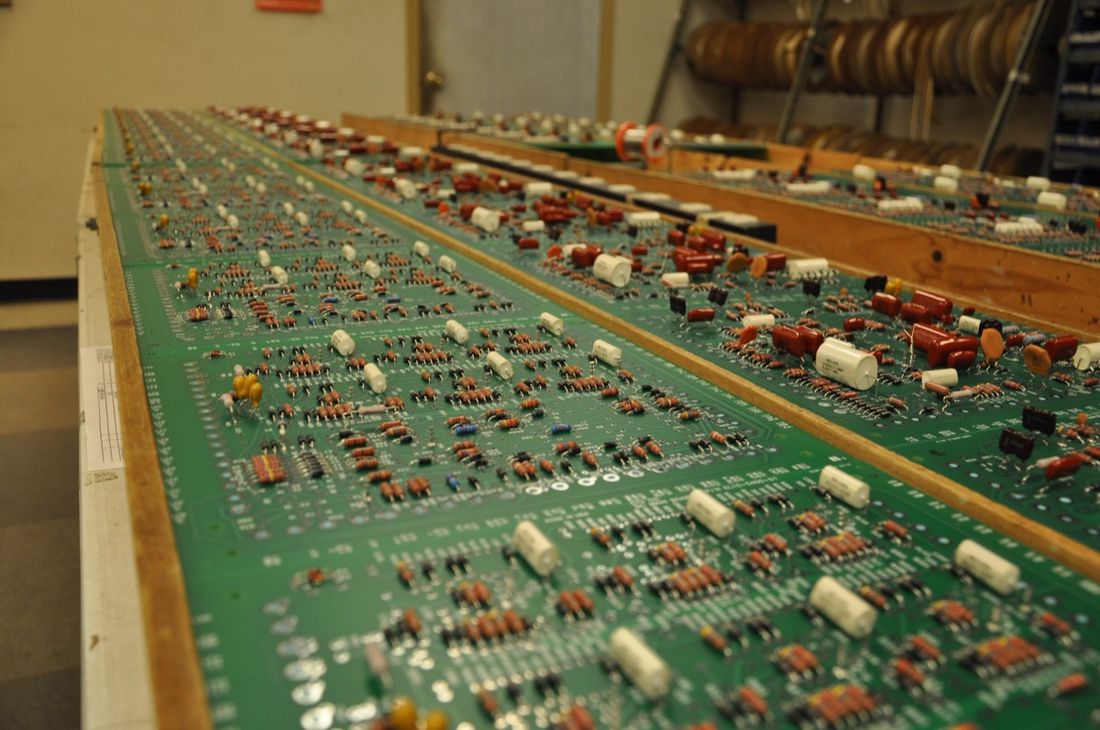


Generator & Exciter PCBs
Every volt the rig burns starts at the generator terminals, & what holds those terminals steady is the excitation loop. ETSCO supplies replacement generator & exciter printed circuit boards for (Ross Hill, Hill Hayes, Hill Graham, & IPS) style SCR houses — the boards that feed the exciter field & hold generator output where the (AC) module asks it to sit.
These boards live on the generator side of the line-up, inside or alongside the (AC) module. They are not the module chassis itself: a generator exciter board is a plug-in assembly carrying its own legend, part number, & revision, & it is replaced as a board. When one drifts, the whole bus feels it long before anybody opens the cubicle door.
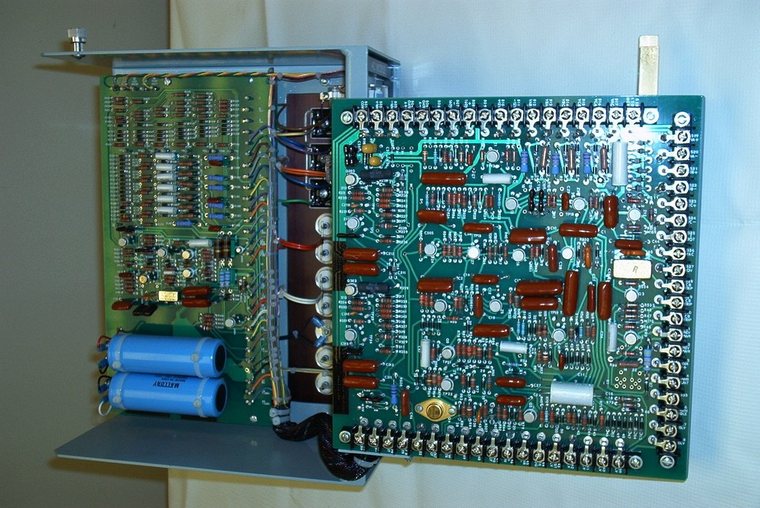
(Ross Hill, Hill Hayes, Hill Graham, & IPS) style
Exciter field supply & generator voltage regulation
By board legend, part number, & revision
How the excitation loop uses the board
The board takes alternating current from the machine it is regulating & hands the exciter field direct current. Two rectifier paths do that job. A diode bridge carries the early work, so the machine can build from residual magnetism without a battery box hung on the front; once output has risen far enough, a silicon controlled rectifier path takes over & the transfer is meant to pass unnoticed. From there the board sits in a loop with the (AC) module holding generator output at its 600 V setpoint, & when a large motor lands on the bus the same loop drives the field harder to pull voltage back up.
That is also the shape of the failure. A machine that will not build at all points at the buildup path; a machine that builds, runs a while, then collapses points at the transfer or the running path; voltage that sags & recovers slowly under a mud pump start points at the regulating loop rather than the rectifiers. Flashing the field repeatedly to get a start is the classic sign that a board is being asked to cover for itself.
Ordering replacement generator & exciter boards
ETSCO supports
- Generator exciter & excitation supply boards
- Voltage regulator boards & motor field supplies
- Voltage feedback boards used with the (AC) module
- Excitation boards for every generation of these line-ups
- Related plugs, receptacles, & sensing transformers
Contact ETSCO to confirm current support for the board you need.
Send with your RFQ
- The generator make, frame, & rating the board regulates
- Board legend, part number, & revision exactly as printed
- The module or cubicle position the board plugs into
- Which generation the cubicle belongs to, where that is known
- What the machine does: will not build, builds then collapses, or sags under load
- Component side, solder side, & cubicle nameplate images
***All company, products, logos, & service names contained herein are for identification purposes only.
Use of these names does not imply any endorsements and/or affiliations. All product names & brands are the property of their respective owners.***